TUCANO

TABLE-TOP PLASMA SYSTEM

Tucano represents a vacuum plasma device in tabletop design, capacitive and RF-powered 200W at 13.56MHz. Characterised by its ease of use and simplicity, it is designed for those who need to perform cleaning, modification or activation operations on surfaces of various materials such as metals, plastics, ceramics or paper, as well as for photoresist removal.

It proves to be an ideal option for both clean room R&D and small-scale production.

Among the various treatments that can be implemented, the most significant are:

Microfluidica

Attivazione superficiale e idrofilizzazione di microcanali in PDMS e polimeri tecnici, plasma bonding vetro-polimero e polimero-polimero, funzionalizzazione chimica per biosensori e immobilizzazione biomolecolare, deposizione di coating anti-fouling e biocompatibili, pulizia atomica e decontaminazione di dispositivi microfluidici.

Lab-on-Chip

Attivazione superficiale per l’integrazione di biosensori e biochip, bonding wafer e sealing ermetico di cartucce diagnostiche, funzionalizzazione per l’immobilizzazione di DNA, anticorpi ed enzimi, deposizione plasma di film funzionali ed elettrodi sottili, sterilizzazione a bassa temperatura e pulizia atomica per dispositivi diagnostici miniaturizzati.

Semiconduttori MEMS

  • Removal of photoresist (stripping) and photoresist residue (descumming), a photosensitive polymer used in photolithographic masking processes.
  • Organic incineration, isotropic removal of organic polymers (e.g. polyamides, etc.) and Silicon Oxides/Nitrides.
  • Surface cleaning or modification prior to wire bonding (both bond pads and chip carriers).
  • Isotropic etching
  • reverse engineering applications (removal of passivants, decapsulation and delineation of cross sections)

BioMedical

Cleaning and surface modification to obtain hydrophilic or hydrophobic surfaces, which can be used for example in the following application areas:

  • Prosthetic implants (increased wettability for faster osseointegration)
  • Bonding between different materials (needles on syringes, catheters, etc.).
  • Final ultra-cleaning and removal of organic residues at atomic level after classic industrial washing
  • Sterilisation on heat-sensitive materials

Plastics industry

Cleaning and surface modifications that can be used in the following application areas, for example:

  • Cleaning surfaces before gluing or welding
  • Etching of surfaces before deposits or attack of PTFE and other plastics
  • Activation of surfaces before printing and painting

SEM and TEM microscopy

  • Sample cleaning and preparation
  • Removal of very thin organic layers
  • Hasing of biological tissues
  • Hasing of asbestos sampling filters

Textile industry

  • Cleaning and surface modification of natural and synthetic fibres to increase the hydrophilicity of fabrics prior to dyeing or printing;

Precision Mechanics

Atomic final cleaning of metal and ceramic surfaces after industrial washing to improve their paintability or for other types of coatings (e.g. PVD).

Optics and ophthalmics

  • Final cleaning at atomic level and pre-treatment after industrial washing to improve adhesion of anti-reflective, anti-scratch and similar coatings; curing of anti-scratch and anti-fog layers.
  • Contact and intraocular lenses

Plasma Reactor: A Closer Look

The plasma reactor is an advanced technology with applications across various sectors, from scientific research to industry. This type of reactor uses plasma—a state of matter in which gases are ionized—to generate chemical and physical reactions at low temperatures. The versatility of plasma and its distinctive properties enable it to perform a variety of functions, such as surface modification, material synthesis, decontamination, and sterilization.

How does it work?

A plasma reactor creates an electric field that ionizes the gas, thereby producing charged particles. These particles interact with the surfaces of materials, facilitating various types of chemical reactions. This process is particularly useful, for example, for the deposition of thin films—a key operation in sectors such as electronics, nanotechnology, and photonics—or for surface cleaning and treatment. The ability to precisely control the plasma makes plasma reactors ideal tools for targeted applications that require high performance and consistent product quality.

Plasma reactors also are used in biomedical fields. For example, they can be used for sterilization of surgical instruments, as they can eliminate bacteria and other pathogens without the use of harsh chemicals. Their effectiveness in sterilization is due to the plasma’s ability to penetrate even crevices and porosity, reaching areas that other traditional methods may not be able to treat. In addition, because the treatment takes place at low temperatures, there is no risk of damaging sensitive materials.

Again, plasma reactors are known for their ability to operate at low pressures, which also makes them particularly effective inetching materials. Thanks to their advanced technology, they are able to guarantee optimal results in terms of uniformity and adhesion, crucial aspects in industries such as consumer electronics and optical component manufacturing.

In addition to Tucano, there are several plasma reactor solutions, including. Hummingbird and Falcon RIE. With advanced features, these reactors are designed to meet the requirements of various industrial applications. All plasma reactors are equipped with advanced control systems that enable real-time monitoring and adjustment of process parameters. This feature enhances operational efficiency, enabling high-quality results, optimising processing times and reducing production costs. Their ease of use and simplified maintenance make these solutions ideal for a wide range of applications, from the aerospace sector to academic research.

So what can we expect from plasma reactors in the future? Their adoption in industry represents a step forward in technological innovation, enabling companies to remain competitive in a constantly evolving market. With increased research into nuclear fusion, plasma reactors could also play a key role in the development of new sources of clean, sustainable energy.

In conclusion, plasma reactors are a versatile and constantly evolving technology with a wide range of applications. Le soluzioni di reattori al plasma proposte da Gambetti Kenologia These are examples of how plasma technology can be used to meet modern needs, helping to improve efficiency and sustainability across various sectors.

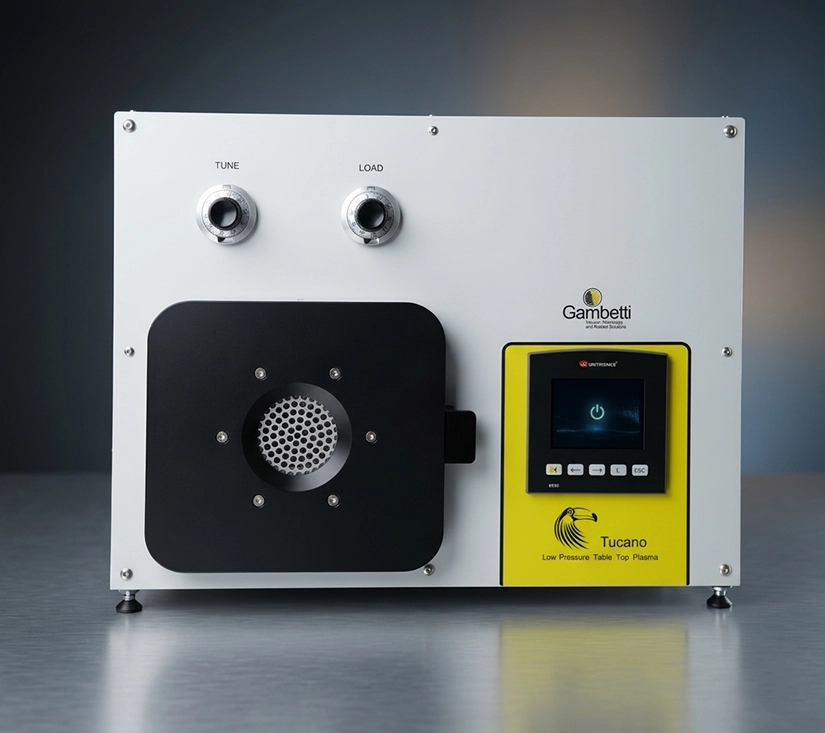
Product features

  • Desktop plasma system, simple and easy to use
  • Possibility of storing up to ten recipes
  • Excellent value for money
  • Highly repeatable processes
  • Primary brands components used, such as vacuum gauges and mass flow controllers (MKS Instruments)
  • Adjustable RF power level in the range 1W to 200W
Technical Specifications
Dimensions W x D x H – Footprint 482 x 532 x 385 mm
Net Weight 33 kg
Clearance Distances Rear – 300 mm
Chamber Material Aluminum
Maximum Volume 5.9 liters – Ø 153 mm W 324 mm
Elettrodi Configurazione elettrodi Piani e paralleli + Dark Shield
Active work area/Tray 118 mm x 310 mm
Useful distance between electrodes 68 mm
Material Aluminum
RF Signal Maximum power 2 to 200 W, in 1 W increments
Frequency 13.56 MHz
Process gases Available flow rates 2–50 sccm
Maximum number of gases 2 (Mass Flow Controller)
Control interface Control PLC
User interface Touchscreen display
Services Power Supply 100–240 VAC, 5.2 A, 50/60 Hz
Process Gas Connection, Type and Dimensions 6 mm OD, Compression Fittings
Process Gas Pressure 1 bar min. to 1.5 bar max. regulated
Vent Gas Connection, Type and Dimensions 6 mm OD, compression fittings
Purge Recommended gases N2, Air
Purge Gas Pressure 0.8 bar min. to 1 bar max., adjusted
Exhausts NW16 ISO-KF
Compliance International CE Marked

Available Vacuum Pumps

  • Edwards RV5 – Two-stage rotary vane pump with standard lubrication, for processes involving air or inert gases.
  • Edwards RV5FX – Two-stage rotary vane pump in PFPE configuration, with Fomblin lubricant, for oxygen-related processes.
  • Edwards nXDS6i – Dry scroll pump with no oil in the pumping chamber, for processes that require the absence of lubricant contamination.
  • Edwards nXDS6iC – Dry scroll pump in a chemical-grade version, with enhanced corrosion resistance, for applications requiring chemical compatibility and an oil-free pumping chamber.

Form richiesta brochure


  Accetto l'informativa sulla privacy policy.

* Questi campi sono obbligatori.